
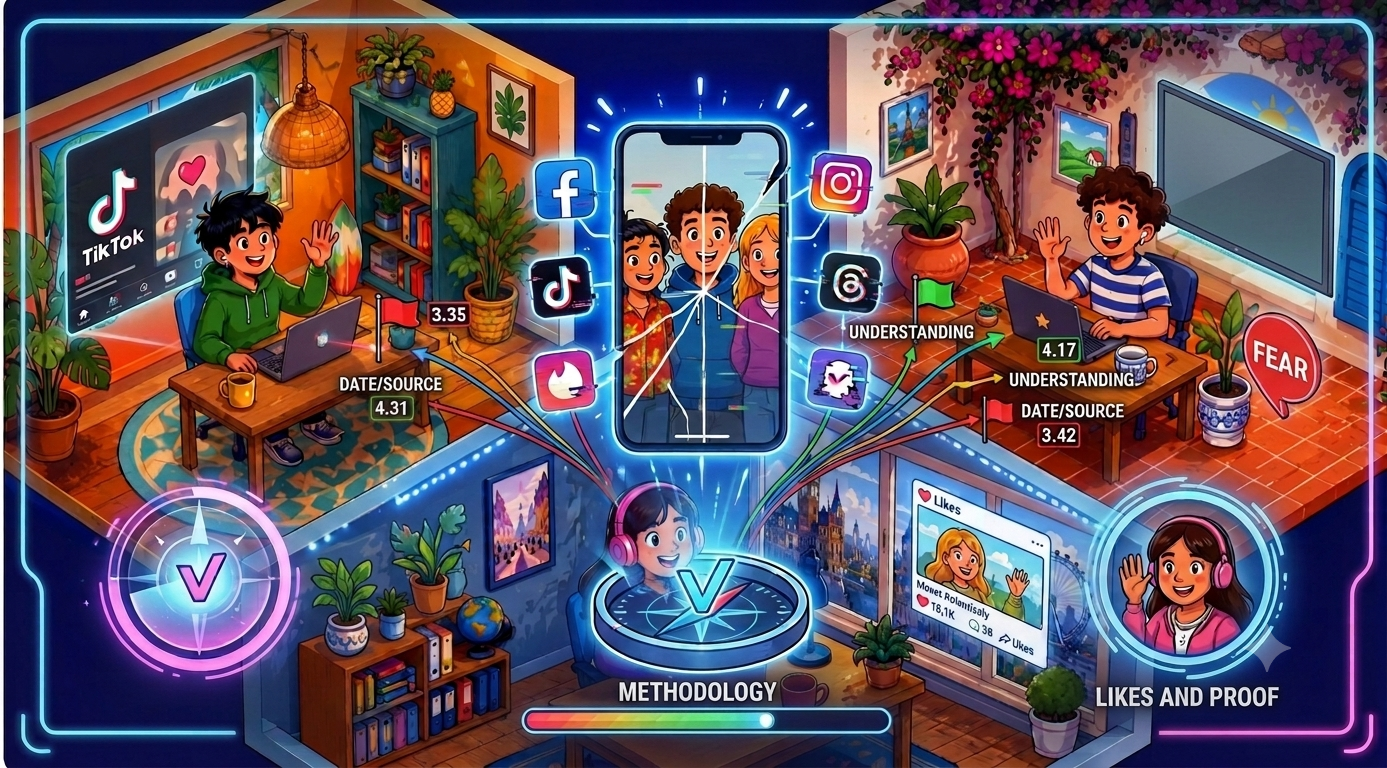
The ImmuniFact Cross-Country Needs Assessment Report is now published. It brings together three national surveys (211 respondents aged 18–30) and four focus group discussions with 36 youth work practitioners across Spain, Croatia and New Caledonia. It is the evidence base for everything ImmuniFact will build next — the Innovative Learning Methodology and the Media Literacy Compass.
Here is what we found.
Emotional manipulation isn’t an occasional problem. It’s the water they swim in.
In all three territories, exposure to content designed to provoke strong emotional reactions was the highest-scoring item in the entire survey: 4.46 out of 5 in Spain, 4.48 in Croatia, 4.37 in New Caledonia. Between 83% and 90% of young people rated it 4 or 5.
Youth workers confirmed it from the other side. Platform architecture is built to trigger a reaction before a critical filter can engage. Any methodology that treats emotion as a footnote to logic is starting in the wrong place.
Knowing how algorithms work doesn’t mean checking the date.
In Spain and Croatia, the strongest self-rated competence was understanding algorithmic influence (4.31 and 4.17). The weakest was the simple practical habit of checking the date and source of a piece of content (3.35 and 3.42).
That gap between abstract awareness and applied behaviour was the single most consistent finding of the research. Young people can explain the recommendation engine and still forward the post.
The trust paradox
Social media is the least trusted source category in every dataset (2.13 in Croatia, 2.26 in Spain). It is also the primary news channel for the majority of respondents in every dataset.
This is not ignorance. It is structural dependency: there is no equally accessible alternative. Fact-checking platforms, meanwhile, scored as the most trusted source category across all three samples which tells us there is real appetite for verification to build on.
Three territories, three different frontlines
The shared patterns argue for a common methodological core. The differences argue for careful local adaptation.
- Spain — practitioners are alarmed by toxic relational content: TikTok material presenting control and surveillance as love, absorbed by adolescents from around age 15. It doesn’t appear anywhere in the survey data, because young people don’t recognise it as a media literacy issue.
- Croatia — AI-generated content is already a documented reality, not a future risk: synthetic video of the Croatian president, fabricated war imagery. 83% of practitioners named fear as the emotion disinformation exploits most.
- New Caledonia — credibility is decided by who shares content, not what it contains. As one participant put it: the more likes there are, the more it must be true. Practitioners also had no shared definition of basic terms like prebunking or polarisation — a professional infrastructure gap in itself.
What comes next
The report closes with twelve design priorities for the ImmuniFact methodology. The short version: start with emotion, build habits rather than knowledge, use real content from real feeds, put peer dialogue at the centre, address AI-generated content head-on, and design for inclusion from the first line rather than retrofitting it at the end.
The full Cross-Country Needs Assessment Report is available to download from the ImmuniFact website.
ImmuniFact is an Erasmus+ KA210-YOU small-scale partnership led by Conseil de la Jeunesse Territorial (New Caledonia), with Backslash (Spain) and Udruga Zaželi (Croatia). Co-funded by the European Union. Views and opinions expressed are those of the author(s) only and do not necessarily reflect those of the European Union or EACEA.
Leave a Reply